Mattress & Sleep Basics
Adjustable Beds: How to Plan for Mattress Fit and Pillow Support
An adjustable bed can turn a flat sleep surface into a flexible place to rest, read, or ease into sleep. The best setup depends on more than the base: mattress flexibility, size, bedding fit, and pillow support all need to work together when the bed changes position.
Think of the bed as a system
An adjustable base changes the angle of the mattress by raising the head, the foot, or both. That movement can make a familiar bed feel quite different. A mattress that is comfortable when flat may respond awkwardly when bent, and a pillow that suits your usual sleep posture may feel too high once the upper body is elevated.
Planning ahead helps avoid the most common mismatch: choosing an adjustable base first and discovering later that the mattress is too rigid, too heavy, or otherwise unsuitable for its movement. Before buying or rearranging a bed, consider the mattress, base, frame, bedding, and pillows as parts of one coordinated setup.
Start with the practical details. Check the mattress manufacturer’s guidance on adjustable-base compatibility, confirm the base’s dimensions and weight limits, and make sure the bed frame or platform can accommodate its design. Then think about how you intend to use the different positions. A setup for occasional reading may call for different pillow choices than one used regularly with the head raised.
Check mattress compatibility before anything else
Not every mattress is designed to flex repeatedly. Adjustable bases typically bend at specific points, so the mattress must be able to move with the platform without buckling, separating, or losing its intended support. Always check the manufacturer’s instructions for the exact mattress model; a general label such as “foam” or “hybrid” is not enough to establish compatibility.
Foam mattresses are often flexible, but their construction still matters. Dense, thick, or unusually rigid designs may not articulate as smoothly as a more pliable mattress. Latex can also flex, although the feel and movement depend on the layer design and overall build. Innerspring and hybrid mattresses vary widely: some are made for adjustable bases, while others may not bend safely or comfortably. Ask the manufacturer rather than assuming that a particular material guarantees compatibility.
Construction is only one part of the decision. Mattress thickness and weight can affect how easily the base lifts and how securely the mattress stays in place. A very heavy mattress may place additional demands on a base, while an unusually thick profile may not move as intended. Check both the base’s specifications and the mattress guidance, and treat the lower limit as important too: some bases have requirements about mattress thickness or construction.
If you already own a mattress, look for its care guide, warranty terms, or product support page. Confirm that using it on an adjustable base is permitted and whether there are restrictions on the base type. This matters because an incompatible setup may affect comfort, performance, or warranty coverage. If you are choosing a mattress at the same time as a base, compare the two products’ specifications before making a commitment.
- Verify that the mattress is explicitly approved for adjustable-base use.
- Check the mattress dimensions against the base, including split configurations.
- Compare mattress weight and thickness with the base’s stated limits.
- Review warranty and care instructions for use on a moving foundation.
- Ask the manufacturer about unusual constructions, toppers, or accessories.
Consider how thickness, weight, and surface layers behave
A mattress does not move in isolation. A topper, protector, or other thick layer can change the way the surface bends and how securely everything stays in place. A thin, well-fitted protector is usually easier to manage than a bulky stack of layers, but product instructions should guide the decision. If you use a topper, confirm that its materials and attachment method are suitable for an adjustable bed.
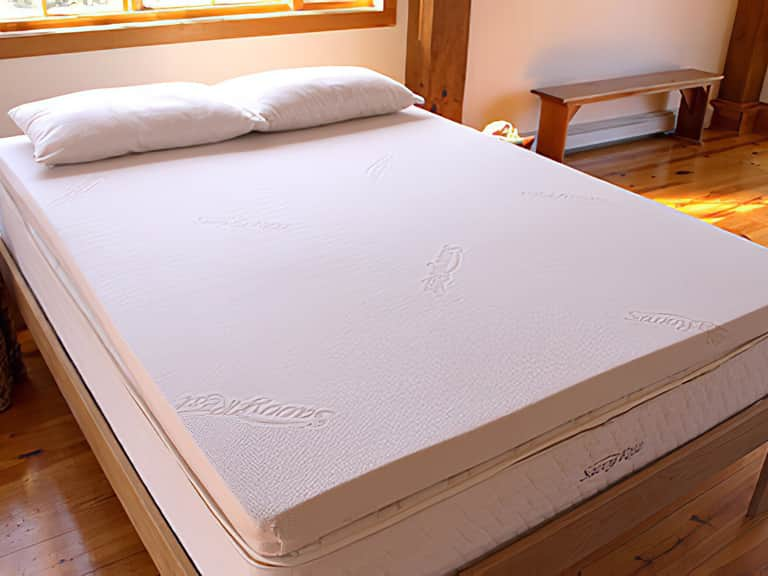
For instance, a three-inch latex topper adds cushioning and can alter the total profile of the sleep surface. The Savvy Rest Vitality Latex Mattress Topper is a three-inch layer of natural Talalay latex in an organic cotton cover. Before pairing any topper with a moving base, consider its flexibility, how it is secured, and whether the mattress-and-topper combination remains within the base’s operating guidance. A soft layer may feel pleasant while flat but can shift or bunch when the bed articulates if it is not properly fitted.
Weight distribution also affects movement. A mattress that slides toward the foot or head during adjustment can interrupt comfort and may require frequent repositioning. Some bases include a retaining bar or other mattress-retention feature; check how it is intended to be used and whether it suits the mattress. Do not add improvised restraints that could damage the cover or interfere with the base.
Match the base to the room and bed frame
An adjustable base needs enough clearance to move freely, and the surrounding furniture should not obstruct its operation. Measure the room, doorway, bed frame, and intended placement before delivery. Confirm whether the base is designed to sit inside a compatible frame, on a platform, or directly on the floor. A base may be described as suitable for certain frame styles, but exact fit depends on its dimensions and the furniture in your room.
Some adjustable systems offer independent head and foot movement, preset positions, or adjustable legs. These features can make the setup more adaptable, but they also add details to consider: leg height affects the bed’s overall profile, while a split arrangement can require separate mattresses and bedding. Check whether you need a single-piece mattress or two Twin XL mattresses, and verify how the base is controlled on each side.
When sharing a bed, discuss how each person plans to use the controls. A split adjustable arrangement may allow each sleeper to select a different position, while a single mattress on a shared base generally moves as one surface. The right choice depends on the room, the mattress, and the preferences of both sleepers. Confirm the size and configuration with the base manufacturer, especially before ordering fitted sheets or replacement bedding.
Choose pillow support for the position, not just the pillow label
Raising the head changes the relationship between your head, neck, shoulders, and upper back. A pillow that feels supportive while lying flat may push the chin forward or leave the neck unsupported when the bed is inclined. Rather than relying on labels such as “side sleeper” or “contour,” assess how the pillow holds your head in the position you actually use.
Begin with the pillow you already know. Raise the head gradually, then notice whether your chin is tipping toward your chest, your head is falling backward, or your neck feels unsupported. A comfortable position should feel relaxed rather than strained. Small adjustments to the base and pillow can make a noticeable difference; more loft is not automatically better, and a steep incline may change the pillow height you need.
Sleep posture remains relevant. Side sleepers often need enough loft to fill the space between the shoulder and head, but the required height depends on shoulder width, mattress softness, and the degree of elevation. Back sleepers may prefer a lower or more shaped pillow that supports the natural curve of the neck without pushing the head too far forward. Stomach sleeping generally calls for a low profile, though an inclined position may make stomach sleeping uncomfortable or impractical for some people.
If you use a contour design, test both the shape and the loft at several base angles. A molded latex option such as the Savvy Rest Organic Latex Contour Pillow has a higher and a lower edge, with a center hollow to cradle the head. Its firm feel and shaped profile may suit some sleepers, particularly those seeking defined neck support, but personal comfort varies. A contour pillow is not automatically the right fit for every sleep position or every adjustable-bed angle.
Make pillow adjustments gradually
It can be tempting to change the base angle and pillow all at once. A more useful approach is to adjust one element at a time. Set the bed to a comfortable incline, lie in your normal position, and assess how your head and neck feel. If support seems wrong, try changing the pillow’s orientation or height before moving the base again. This makes it easier to identify what is helping.
Keep in mind that changing the head elevation can move the body slightly toward the foot of the bed. That shift may affect how the pillow sits beneath you, especially if the mattress surface is smooth or the bedding is loose. If you find yourself sliding, reduce the angle, check the mattress fit, and examine whether the base and bedding are being used as intended.
Allow a little time to assess a new setup, but do not try to push through persistent discomfort. If a position causes pain, numbness, or unusual symptoms, return to a comfortable position and consider seeking advice from a qualified healthcare professional. Adjustable-bed positioning is a comfort choice, not a substitute for medical evaluation or treatment.
Keep sheets and bedding secure as the bed moves
Fitted sheets that are too shallow or too loose can pull free when the bed bends. Check the pocket depth against the complete mattress profile, including any topper, and look for a secure elastic fit that does not distort the mattress corners. If the bed has separate adjustable sides, confirm that the sheet configuration is intended for that arrangement. Oversized or incompatible bedding can bunch at the hinge points or interfere with movement.
Flat sheets, blankets, and duvets can also migrate as the head or foot rises. Leave enough room for movement without tucking layers so tightly that they pull against the mattress. Lightweight, breathable bedding may be easier to reposition, while heavy blankets can feel more cumbersome as the angle changes. The best choice depends on the season, the room, and personal preference.
Pay attention to cords and small bedside items. Keep charging cables, remote controls, and other objects clear of the moving joints and underside of the base. Use built-in storage or charging features only as directed, and ensure cords cannot become trapped during adjustment. Before using a new setup, raise and lower the bed slowly while checking that sheets, blankets, and nearby objects remain clear.
- Measure mattress depth with any topper included.
- Choose fitted sheets that stay secure without compressing or pulling the mattress.
- Keep blankets loose enough to move with the bed.
- Check that bedding does not catch at moving sections.
- Keep cables and loose objects away from the base’s moving parts.
Build a practical adjustment routine
Comfort is often easier to find through a simple routine than through frequent, dramatic changes. Start with the bed flat, then raise the head or feet in small increments. Pause between adjustments and notice whether the position feels relaxed, stable, and easy to maintain. If the base offers presets, treat them as convenient starting points rather than universal recommendations; your preferred position may differ from a factory setting.
Consider what you are doing in each position. Reading or watching a programme may call for more elevation than sleeping. A position that feels pleasant while awake may not remain comfortable throughout the night. If you plan to sleep with the bed raised, check that the pillow supports your head without forcing your neck into an awkward angle and that you are not sliding down the mattress.
Record the positions that feel best if the base includes memory settings. Note the pillow arrangement, too, so you can return to a comfortable setup without trial and error. On nights when you feel different or have changed your bedding, reassess rather than assuming the same angle will always feel ideal.
A balanced setup checklist
Before settling into an adjustable bed, use this quick review to catch compatibility and comfort issues:
- Confirm compatibility: The mattress manufacturer approves the mattress for use on the chosen adjustable base.
- Check dimensions and limits: Mattress size, weight, and thickness meet the base specifications.
- Review the frame: The frame or platform accommodates the base and leaves room for movement.
- Fit the layers: Any topper, protector, and fitted sheet remain secure when the bed is raised.
- Test pillow support: Your head and neck feel neutral and relaxed at the angles you intend to use.
- Clear the moving area: Cables, bedding, and objects stay away from hinges and mechanisms.
- Use gradual adjustments: Raise or lower the bed in small steps and stop if the position feels uncomfortable.
Common setup mistakes to avoid
Assuming every mattress will work. Similar-looking mattresses can differ in their construction and flexibility. Check the exact model’s guidance rather than relying on broad assumptions about foam, latex, or spring designs.
Ignoring the total mattress profile. A topper adds height and weight, and may affect how the surface bends. Consider the whole stack, not only the mattress itself.
Keeping the same pillow by habit. Your familiar pillow may still work, but its feel can change as the bed tilts. Reassess loft and shape in the positions you plan to use.
Overlooking bedding fit. Sheets that seem adequate on a flat bed may loosen or pull free when the mattress articulates. Check pocket depth and fit with the bed raised.
Choosing the steepest setting by default. More elevation does not necessarily mean more comfort. Begin gently and use only the angle that feels appropriate to you.
Forgetting the manufacturer’s instructions. The base and mattress have specific operating and care guidance. Following it helps protect the products and clarifies how to use any accessories safely.
Frequently asked questions
Can I use my existing mattress on an adjustable base?
Possibly, but confirm compatibility with the mattress manufacturer before placing it on a moving foundation. The mattress must be designed to flex, and its dimensions, weight, and thickness should suit the base. Also review any warranty conditions that apply to adjustable-base use.
Does mattress type determine compatibility?
Material can provide clues, but it is not a definitive answer. Foam, latex, innerspring, and hybrid mattresses vary in flexibility and construction. Check the specific model’s instructions rather than making a decision from the category name alone.
Do I need a special pillow for an adjustable bed?
Not necessarily. Your current pillow may work well if it keeps your head and neck comfortable as the bed moves. The useful test is how it feels in your preferred position, not whether it is marketed for adjustable beds.
Will regular sheets fit an adjustable bed?
Often, provided their size and pocket depth match the mattress, including any topper. A secure fit is especially important because sheets can shift when the base raises or lowers the mattress. Split arrangements may require bedding designed for their configuration.
How high should I raise the head of the bed?
There is no single angle that suits everyone. Start with a modest elevation and adjust gradually until your neck and body feel relaxed. If a position causes pain or other concerning symptoms, stop using it and consult a qualified healthcare professional as appropriate.
The final fit is personal—and practical
An adjustable bed works best when its components move together without friction: a compatible mattress flexes as intended, bedding stays in place, and pillows support the head and neck at the chosen angle. The process is less about finding one perfect setting than about understanding how each adjustment changes the feel of the whole sleep surface.
Begin with compatibility and measurements, then test positions patiently. Revisit pillow loft as the bed angle changes, keep sheets and layers secure, and follow the instructions for both mattress and base. With those fundamentals in place, an adjustable-bed setup can feel considered, comfortable, and genuinely suited to the way you use your bedroom.